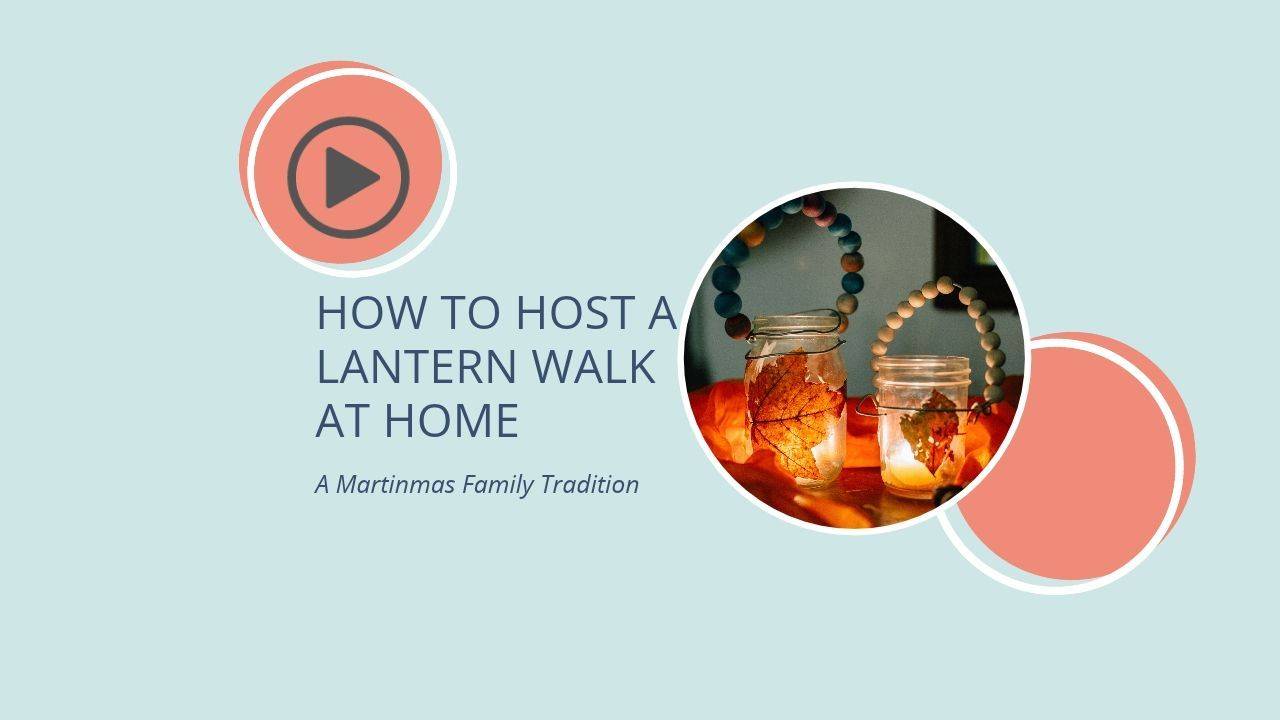
How to Host a Lantern Walk at Home
For over a decade, I ran the Little Round Schoolhouse, a mixed-age kindergarten for children ages three to six, in a yurt in a forest in Western North Carolina's.
What I loved most was helping families carry the magic of that classroom into their own homes—and what families asked me about most was how to celebrate the seasonal festivals at home with their children.
The lantern walk was the most beloved of all the festivals we held.
Let me start by telling you what it was like to come to ours, and then I’ll show you how to hold one yourself.
What a Lantern Walk Feels Like
Imagine you are a parent at the Little Round Schoolhouse. The lantern walk has been on your calendar since the start of the school year, on an evening in early November.
You feed your children dinner, dress them in layers, and drive to the park in the dark with the radio off.
You are greeted at the pavilion and handed your child’s lantern — the one they have been working on at school for weeks. You hold it, but you don’t light it yet. Families gather by the fire and children stay close.
At six o’clock there is a puppet show. It ends with a little boy receiving a small spark of light from the sun, which he carries home inside a lantern he has made himself.
And at that moment, every lantern is lit.
We begin to sing — “This Little Light of Mine,” usually, because most families already know it and the ones who don’t pick it up quickly. After a couple of times through, I start down the path, which is lined on both sides with luminaries. Everyone follows. We walk slowly, singing the whole way. It takes five to seven minutes to walk the path.
The path loops back to the pavilion, where we gather and sing once more. Then I say a closing verse and wish the families well. Each child collects a roasted apple on the way to the car, and families drive home quietly.
The whole festival lasts about an hour. Its beauty is really beyond description — out under the stars and the moon in the darkness, carrying a small flame you made yourself. To a child it feels like magic, and they have had weeks of anticipation building toward it.
Where the Tradition Comes From
The lantern walk is traditionally held around November 11th, the feast of St. Martin — which is why you will also hear it called Martinmas.
The story behind the date: St. Martin was a Roman soldier who came upon a beggar freezing at the city gate. While everyone else walked past the beggar without helping, Martin cut his own cloak in half and gave the man one piece. Martin said he recognized the light of humanity that he shared with the beggar and did something to help. It was a small but powerful act.
One little light, carried carefully, does more in the dark than you would expect.
Waldorf communities have held lantern walks for generations as the days darken. You do not need to be part of a Waldorf school to celebrate this beautiful festival. The dark days of late autumn call us inward, and a lantern walk gives us time to honor this. It celebrates turning inward: a quiet, reverent time to gather together.
You Only Need Two Things
At minimum, a lantern walk takes two things:
- A path to walk
- Lanterns to carry
That’s it. Everything else on this page may be lovely, but none of it is required.
When people first hear how I celebrate the lantern walk, they often decide immediately that their family can’t do it—they live in an apartment, in a city, or they have no space that is theirs to walk on. Don’t worry. Families I know all over the world have adapted this to fit where they live.
Finding Your Path
If you have a yard
A yard of any size will do. Even a small one — a simple path around the outside edge is a path. Where I live, we have more space, so we mow a path around the yard and line it with luminaries.
If you live in a city or an apartment
Choose a route and walk the same one year after year. That repetition becomes its own tradition, and children learn the walk by heart. You may not be able to line a city sidewalk with luminaries — though I do know families who have gotten away with it.
If you want more space: rent some
This is what I did for our school families, and it works just as well for one family or a few close ones. I rented a pavilion at a city park, and the park itself emptied out once it got dark. Most public parks close at dark, so I asked permission for our group to stay a little later — I told them what we were doing and how long we would be there.
It is a lovely way to get a bit more land, and to walk somewhere away from the lights of the city.
Lighting the Path with Luminaries
Luminaries are the lights that line your path, and they are the simplest thing on this list to make:
- Take a white paper bag — white gives a much nicer glow. (A brown bag might work; I haven’t tried it.)
- Put a little sand in the bottom. This keeps the bag where it is supposed to be when the wind blows.
- Set a light in the center, on top of the sand.
- Space them along both sides of your path, and light them just before people gather — not an hour early.
This step is optional. You can walk around the block or around your own yard without lining anything, but it adds a lot of extra magic, if you can.
A Note on Fire Safety
Worth reading before you plan anything, because my own practice changed over the years.
For the first seven years of our lantern walks, I used a real tea light in the bottom of each luminary bag. I made sure that wherever we walked there were no dry leaves or dry grass near the bags, in case one caught fire. I always had a fire extinguisher on hand—and, just as importantly, one person whose job it was to know where it was and to know they were the one who would use it.
Then one year we had forest fires in my town and the whole place filled with smoke. I am not from an area where that usually happens, and it was new to me and to a lot of people here.
That year, and every year since, I have used LED lights inside the luminaries. Nothing can catch fire. I buy the kind that flicker as they glow, so they still look like real candles inside the bag.
I do still use real tea lights inside the lanterns the children and adults carry. That small live flame really is part of the magic. But if a real flame doesn’t suit your family, an LED tea light goes in the same lantern and looks very nearly the same in the dark. A lantern walk with LED lights is still a lantern walk.
Making the Lanterns
There are many ways to make a lantern. The simplest I have found is a glass jar.
If you have time, ahead of time by two or three weeks. Part of what made our walk feel enormous to the children was that they had been working on their own lanterns since the beginning of October. The anticipation is half the festival.
The jar lantern
Take a glass jar. Decorate the outside with pressed autumn leaves, or cover it with torn tissue paper, using Mod Podge or white glue thinned slightly with water to hold everything to the glass. Add a handle of thin wire — plain, or beaded if you like. A little sand in the bottom holds the tea light upright.
The full steps, if you want them:
- Tear the paper. Tear tissue paper into small pieces. For younger children, keep it simple and random. Older children and adults may want to cut shapes and make scenes.
- Apply glue to the jar. Working in sections, paint a layer of glue onto the glass.
- Place the paper. Gently press pieces of tissue paper onto the glue. Don’t worry if edges stick up — they get glued down later.
- Keep going all the way around the jar: glue a section, lay the paper, move on.
- Add layers. Repeat once or twice more. Two or three layers is where the color gets rich.
- Seal it. Brush a final layer of glue over everything and let it dry completely.
Adding the wire handle
- Cut about two feet of thin wire.
- Use needle-nose pliers to form a loop at one end.
- Hold the looped end against the jar neck and wrap the wire around it.
- Pull it tight and hook the wire into the loop you made.
- Pull the wire up and bend it over to form the handle.
- Feed the end down under the neck wire on the opposite side and twist it closed.
A sturdy forked stick, found on the walk itself, makes a lovely thing to hang the handle from.
Other lanterns we like
- Watercolor paper lanterns. Let your child paint a sheet of watercolor paper, oil the paper once it is dry so the light comes through, fold it, and add a handle.
- Tin can lanterns. Hammer little holes all over the sides of a tin can with a nail, so the light shines through. Best for older children.
- A plain jar with a wire handle. No decoration at all. A glass jar with a candle in it is still beautiful in the dark — and if you are reading this on November 10th, this is your lantern.
Setting the Tone
This is the part that is easy to skip and makes the biggest difference. A lantern walk is quiet and reverent, and you have to build that mood before anyone picks up a lantern.
- Start before you leave the house. Turn off the radio and music. Use quiet voices. We asked families to do this in the car on the way to the festival and on the way home, and you can do the same as you walk out your own back door.
- Tell the children it is a quiet festival — and then expect young children to make noise anyway. Nobody will be perfectly silent, and that is fine. You are setting a mood, not enforcing a rule.
- Eat dinner first. Arrive with full bellies.
- Pajamas as the bottom layer. Many of our families did this, so children could come home and go straight to bed.
- Layers. It can be quite chilly. Layers are a necessity.
- Practice carrying a lantern ahead of time. Walking while holding a lit lantern is a real skill — slow steps, lantern held away from clothing and away from the person in front. We practiced at school for weeks. Avoid long, flowing fabric, and tie long or loose hair up.
- Carry the quiet home with you. Drive or walk home without the radio or loud voices. Consider lighting only one or two candles at home as you finish the evening and get the children ready for bed. This is what makes the evening feel like it extended past the walk itself.
Taking the Walk
- Gather after sunset, as the sky is darkening.
- Hand out the lanterns, unlit. Each person carries their own, by the handle or hung from a forked stick.
- Gather in a circle and light them together. Then stand quietly for a moment and simply take in the beauty of all those small flames. Don’t skip this part.
- Begin to sing. Sing it through once or twice before anyone moves.
- Set off along the path, slowly and carefully, singing as you go.
- Circle up again at the end, sing once more, and say a closing verse.
Plan a route that loops back to where it started. It means nobody has to turn around in the dark, and the walk ends where the group began. Five to seven minutes of slow walking is about right. Choose ground that is relatively flat and free of obstacles — fallen branches, rocks, roots. You will be walking after dark and may not see clearly.
If you are walking with more than one family, decide ahead of time who leads and ask everyone to stay behind them. Children very much want to run ahead with a lantern, and one child running sets off the rest.
Three Things That Make It a Celebration
None of these are required. All three are what children remember.
A song
We always sang “This Little Light of Mine.” Most families already know it, so nobody has to learn anything that night, and people feel confident enough to sing while they walk. Practice it together beforehand if you can. Any song that suits your family works just as well.
If you’d like more, there is a collection of nine Waldorf lantern walk songs on YouTube, recorded so parents and teachers can learn them and lead the singing themselves.
A story
A story pulls the whole experience together. I have told one at the beginning of the walk and at the end, and both work. At school we did ours as a puppet show, and the story ended with a child receiving a spark of light from the sun to carry in his lantern — which is the moment every lantern in the circle was lit. If you want to go the extra mile, a puppet show is worth it.
Special food
Having one food you make every year for the lantern walk is a quiet kind of magic — children start asking for it in October. Ours is roasted apples, handed to each child on the way home:
- Cut a large triangular wedge out of an apple.
- Add a squirt of lemon juice.
- Add coconut oil or butter, then a shake of cinnamon.
- Close the wedge back up.
- Wrap the apple in tin foil and roast it in the oven or over a fire.
Open them up warm. They are so yummy.
Your Ingredients for a Lantern Walk
- A path
- Lanterns
- And perhaps a story, a song, and something good to eat
That’s all it takes. If you try this with your family, I would love to hear about it.
More Late Autumn Resources
- A House for the Sun’s Spark — a story about carrying light through the dark season
- Grandpa Ivy & the Hedgehogs — our late autumn harvest story
- Poured Earth Candles — a candle-making craft for the same season
- Pumpkin Fingerplay (Rilla & Billa) — an autumn circle time verse
Free Seasonal Sampler
Love this approach to rhythm and storytelling? Download our free Storytime Seasonal Sampler and experience the gentle rhythm our program provides families like yours. No credit card required.

Make this part of your daily rhythm.
In Storytime, the songs, stories, and crafts follow the rhythm of the seasons... and it's already laid out for you.
Each morning, open the day’s episode and enjoy it with your child. It’s one small moment at the same time each day that's meant to be enjoyed together.
Let that rhythm anchor you, and watch it grow from there with seasonal handwork and afternoon art projects.
First month: $1; standard rate after that. No commitment, easy to cancel. Equity rates available.